
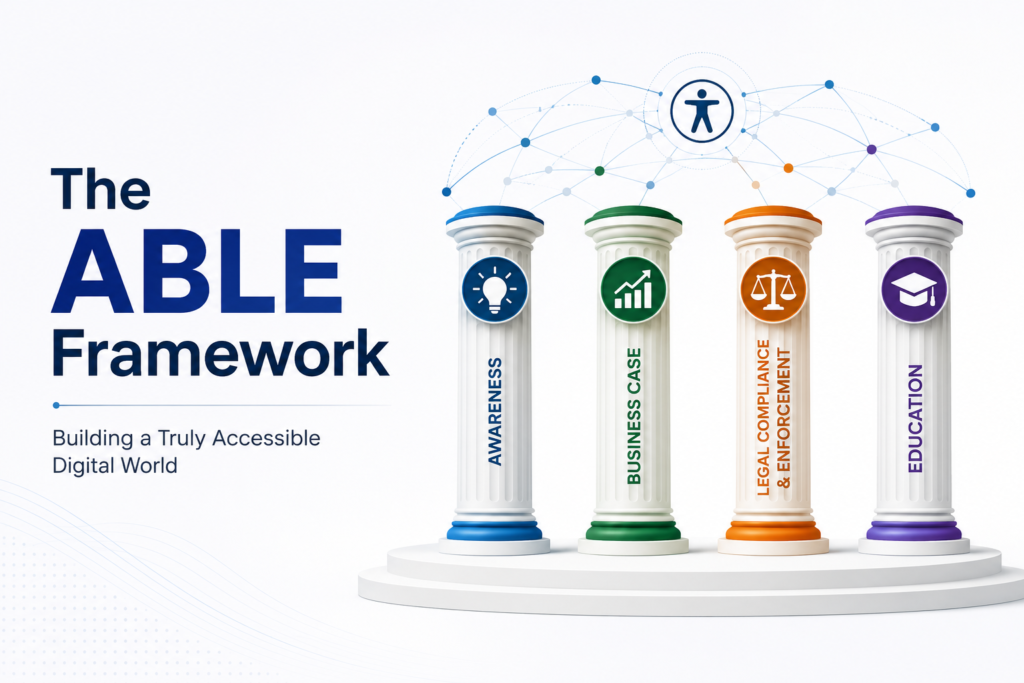
The ABLE Framework: My Perspective on Building a Truly Accessible Digital World
July 3, 2026
By Akashdeep Bansal, Founder & CEO, SaralX
Over the past few years, I have had the opportunity to work with startups, enterprises, educational institutions, and government organizations on digital accessibility. During this journey, I have often been asked a simple question:
“What is the single most important thing required to make digital accessibility a reality?”
My answer has evolved over time.
Initially, I believed awareness was the biggest challenge. Later, I thought stronger laws would solve the problem. Then I realized businesses needed to see the commercial value. More recently, I have become convinced that the answer isn’t a single factor at all.
Today, I believe digital accessibility requires what I call the ABLE Framework.
A – Awareness
B – Business Case
L – Legal Compliance & Enforcement
E – Education
These four pillars are interconnected. If even one is weak, large-scale accessibility adoption becomes difficult.
A – Awareness: The Starting Point
Every meaningful change begins with awareness.
Many developers, designers, product managers, business leaders, and even policymakers still have limited exposure to digital accessibility. Some believe accessibility is only about screen readers. Others think it only benefits people with blindness. Many have never interacted with assistive technologies such as keyboard navigation, voice access, captions, switch devices, magnifiers, or eye-tracking systems.
Without awareness, accessibility never even enters the conversation.
Awareness helps people understand:
- Why accessibility matters
- Who benefits from it
- What barriers currently exist
- How inclusive design improves products for everyone
However, awareness alone rarely changes organizational priorities.
L – Legal Compliance and Enforcement: The Push to Take the First Step
Many organizations begin their accessibility journey because the law requires them to.
This is not necessarily a bad thing.
Legal requirements create the initial momentum. They bring accessibility into boardroom discussions, product roadmaps, procurement processes, and compliance checklists.
But legal compliance alone is not enough.
Enforcement matters just as much.
There is a famous principle in behavioral science: the certainty of consequences often influences behavior more than the severity of consequences.
An organization is far more likely to comply with accessibility requirements if it believes there is a high likelihood of enforcement than if there is only a remote possibility of facing penalties.
In other words, laws without enforcement often become recommendations rather than obligations.
Strong legal frameworks encourage organizations to take the first step.
Consistent enforcement ensures they continue walking.
B – Business Case: The Key to Long-Term Sustainability
While legal compliance may initiate accessibility efforts, it cannot sustain them forever.
Businesses exist to create value.
Every investment—whether in technology, security, marketing, AI, or accessibility—is evaluated against expected returns.
This is where digital accessibility faces one of its biggest challenges.
We know that approximately 16% of the world’s population lives with some form of disability.
But we still lack answers to several important questions:
- How many people are unable to access digital services because of accessibility barriers?
- How many people with disabilities actively use assistive technologies?
- How many potential customers abandon inaccessible websites or mobile applications?
- What is the measurable business impact of inaccessible digital experiences?
Without reliable data, organizations struggle to estimate the return on investment.
It is difficult to justify a significant accessibility investment when leadership cannot confidently answer a simple question:
“What business value will this create?”
This does not mean accessibility lacks value.
Rather, it means we need stronger evidence.
We need better research, better analytics, and better measurement frameworks that demonstrate the commercial impact of accessibility alongside its social impact.
When organizations understand both the ethical responsibility and the business opportunity, accessibility stops being viewed as a compliance exercise and starts becoming part of product strategy.
That is when accessibility shifts from being an afterthought to becoming a design principle.
E – Education: Building Accessibility into the Next Generation
Perhaps the most overlooked pillar is education.
Today, many students graduate with degrees in engineering, design, business, or management without ever learning the basics of digital accessibility.
As a result, organizations spend significant time and resources retraining professionals after they enter the workforce.
Imagine a different future.
Imagine every computer science student understands semantic HTML and keyboard accessibility.
Imagine every design student learns inclusive design principles.
Imagine every product management student knows how accessibility influences user experience.
Imagine every MBA graduate understands accessibility not only as compliance but also as a strategic business opportunity.
Accessibility would no longer depend on specialists alone.
It would become part of the mindset of every professional entering the industry.
The benefits extend beyond workplaces.
Students who understand accessibility become more empathetic citizens. They begin recognizing barriers in everyday life and contribute to building a more inclusive society.
Education creates long-term cultural change.
Why All Four Pillars Matter
The four pillars reinforce one another.
- Awareness creates understanding.
- Legal compliance creates urgency.
- Business case creates sustainability.
- Education creates future readiness.
Remove any one of them, and the ecosystem becomes weaker.
Awareness without legal backing often results in good intentions but limited action.
Legal mandates without enforcement rarely drive meaningful compliance.
Compliance without a business case risks accessibility becoming a one-time project rather than an ongoing commitment.
And without education, we continue producing generations of professionals who must learn accessibility only after entering the workforce.
A Call for Collective Action
Governments, educational institutions, businesses, industry bodies, researchers, and accessibility professionals each have an important role to play.
Governments can strengthen legislation and enforcement.
Businesses can invest in understanding the commercial value of inclusive products.
Researchers can generate better evidence around accessibility outcomes and return on investment.
Educational institutions can ensure accessibility becomes part of mainstream curricula rather than a niche topic.
No single stakeholder can transform digital accessibility alone.
It requires collective effort.
Final Thoughts
The ABLE Framework is not an international standard or an academic model. It is simply a perspective shaped by my own journey working in the field of digital accessibility.
I have come to believe that if we genuinely want an inclusive digital future, we must focus on more than technology or compliance alone.
We need awareness to start the conversation.
We need legal compliance and effective enforcement to create momentum.
We need a compelling business case to sustain investment.
And we need education to ensure the next generation builds accessibility into products from day one.
Only when these four pillars work together can digital accessibility become the norm rather than the exception.
That, to me, is what it means to build an ABLE digital world.