
IAAP Certification: What It Really Means for Accessibility Professionals and Organizations
June 22, 2026
By Akashdeep Bansal, Founder and CEO – SaralX Accessibility Pvt. Ltd.
As awareness about digital accessibility continues to grow, more organizations are looking for ways to demonstrate their commitment to inclusion. During our conversations with clients, partners, and industry professionals, we often come across a common misconception:
“Is your company IAAP certified?”
The short answer is: IAAP does not certify companies. IAAP certifies individuals.
This distinction is important because it helps organizations make informed decisions when evaluating accessibility expertise and maturity.
Understanding IAAP
The International Association of Accessibility Professionals (IAAP) is a global organization dedicated to advancing the accessibility profession. It provides education, networking opportunities, resources, and professional certifications for individuals working in accessibility-related roles.
Over the years, IAAP certifications have become widely recognized benchmarks for accessibility knowledge and competency across industries.
IAAP Certifications Are for Individuals
Just as a university awards degrees to students rather than companies, IAAP awards certifications to individuals who demonstrate accessibility knowledge and expertise.
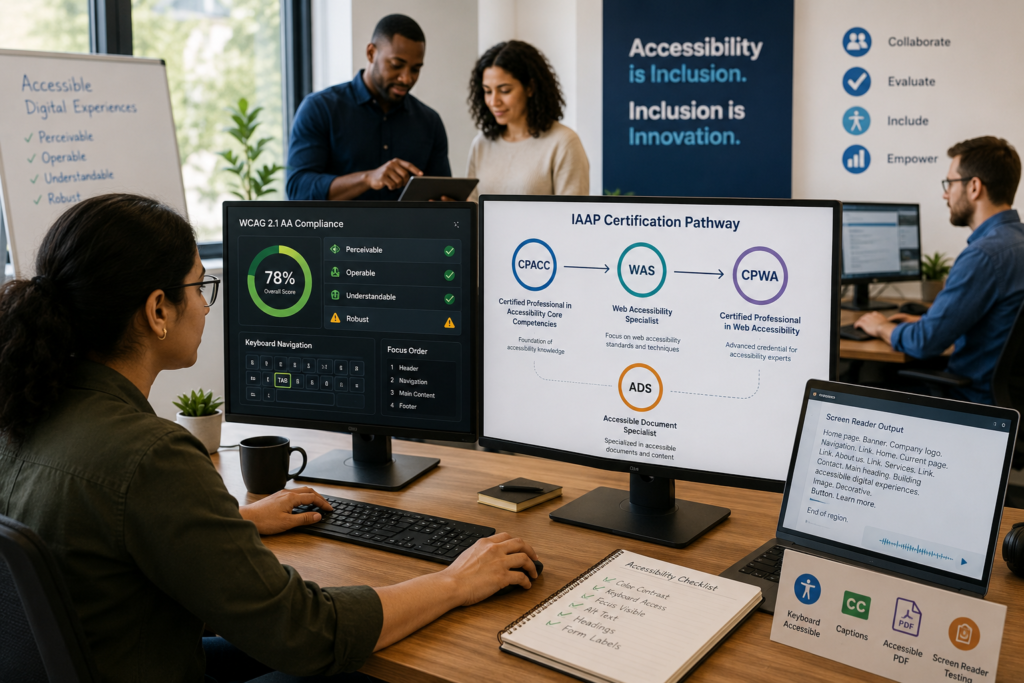
Some of the most recognized IAAP certifications include:
CPACC (Certified Professional in Accessibility Core Competencies)
This certification focuses on foundational accessibility concepts, disability awareness, accessibility laws and standards, and universal design principles. It is often considered the starting point for accessibility professionals.
WAS (Web Accessibility Specialist)
The WAS certification is designed for professionals involved in designing, developing, testing, or managing digital products. It focuses on technical aspects of web accessibility, including WCAG requirements and implementation techniques.
CPWA (Certified Professional in Web Accessibility)
CPWA is an advanced credential awarded to professionals who hold both CPACC and WAS certifications and meet additional requirements.
ADS (Accessible Document Specialist)
This certification focuses on creating and evaluating accessible documents across formats such as PDF, Word, PowerPoint, and other digital content.
When an individual earns one of these certifications, it signifies that they have successfully demonstrated knowledge in the relevant accessibility domain.
Can a Company Be IAAP Certified?
No.
A company cannot obtain an “IAAP Certification” because IAAP certifications are designed exclusively for individuals.
However, an organization may employ multiple IAAP-certified professionals. Having certified team members can be a positive indicator that the organization has invested in accessibility expertise.
That said, the number of certified professionals alone should not be considered a complete measure of an organization’s accessibility maturity. Accessibility success ultimately depends on processes, culture, leadership commitment, user involvement, and consistent implementation across products and services.
What Does IAAP Offer to Organizations?
While IAAP does not certify companies, it does offer organizational membership programs.
These membership plans allow organizations to:
- Demonstrate support for accessibility as a professional discipline.
- Provide learning and development opportunities for employees.
- Access accessibility resources, webinars, and educational materials.
- Engage with the global accessibility community.
- Encourage employees to pursue professional certifications.
An IAAP organizational membership is similar to a professional association membership. It reflects participation in the accessibility community, but it is not an assessment or certification of the organization’s accessibility practices.
What Should Organizations Look For Instead?
When evaluating an accessibility partner, vendor, or internal accessibility program, consider factors such as:
- Presence of IAAP-certified accessibility professionals.
- Practical accessibility implementation experience.
- Experience with accessibility testing using assistive technologies.
- Involvement of persons with disabilities in testing and feedback.
- Understanding of standards such as WCAG, EN 301 549, Section 508, GIGW, and IS 17802.
- Proven track record of accessibility remediation and consultation.
- Established accessibility processes integrated into the product lifecycle.
Accessibility is ultimately measured not by certificates on a wall but by the usability of products and services for people with disabilities.
Final Thoughts
IAAP plays a vital role in building accessibility expertise worldwide. Its certifications help individuals demonstrate professional knowledge and commitment to accessibility. However, it is important to understand that IAAP certifies people, not companies.
Organizations can become IAAP members, support employee certification efforts, and build accessibility competence across teams. But claiming that a company itself is “IAAP certified” is not technically accurate.
As the accessibility profession continues to mature, understanding these distinctions helps organizations make better decisions and promotes greater transparency within the industry.
After all, accessibility is not about collecting certifications—it is about creating experiences that everyone can use, regardless of ability.