
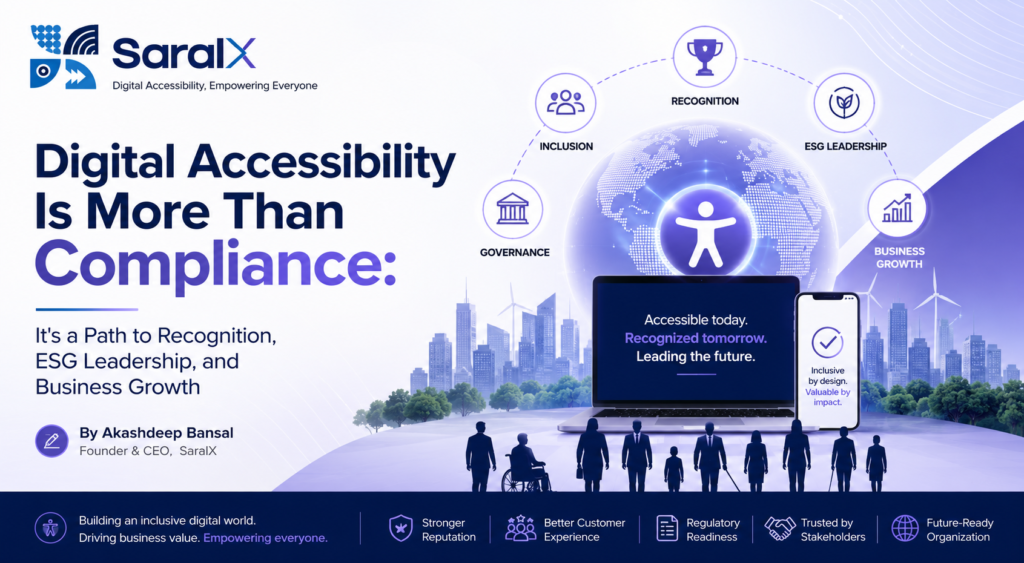
Digital Accessibility Is More Than Compliance: It’s a Path to Recognition, ESG Leadership, and Business Growth
July 15, 2026
By Akashdeep Bansal, Founder & CEO, SaralX
For years, digital accessibility has largely been viewed through the lens of legal compliance. Organizations often begin their accessibility journey only when responding to regulations, customer complaints, or legal risks. While compliance remains important, it tells only part of the story.
At SaralX, we believe the conversation around accessibility needs to evolve.
The future of digital accessibility lies in demonstrating its business value. Beyond improving the experience for persons with disabilities, accessible digital products help organizations strengthen their brand reputation, improve governance, achieve ESG objectives, qualify for prestigious recognitions, and establish themselves as leaders in inclusion.
This is the first article in our series on building the business case for digital accessibility.
Recognition That Goes Beyond Compliance
Every organization invests in initiatives that enhance its reputation—whether it’s sustainability, innovation, cybersecurity, or customer experience. Accessibility deserves a place alongside these strategic priorities.
Across India and globally, several prestigious awards and benchmarking programs recognize organizations that invest in accessibility and disability inclusion. These recognitions not only celebrate inclusive practices but also strengthen employer branding, customer trust, investor confidence, and corporate reputation.
Some notable examples include:
1. National Awards for Empowerment of Persons with Disabilities (India)
Presented annually by the Hon’ble President of India on the International Day of Persons with Disabilities (3 December), these awards recognize organizations making outstanding contributions toward disability inclusion, including accessible information and communication technology. For organizations committed to accessibility, this represents one of the country’s highest recognitions.
2. NCPEDP–Mphasis Universal Design Awards
One of India’s most respected accessibility awards, recognizing organizations that embed universal design into products, services, workplaces, and digital experiences. Companies that prioritize accessible websites, mobile applications, and digital services are well-positioned to be considered.
3. CII Awards for Excellence in Disability Inclusion
Formerly known as the CII IBDN Awards, these awards evaluate organizations across multiple dimensions of disability inclusion, including accessible digital infrastructure, inclusive workplace practices, leadership commitment, and organizational culture. Digital accessibility forms an important component of the overall assessment.
4. Global Accessibility and Inclusion Awards
Internationally, organizations are increasingly being recognized for digital accessibility through initiatives such as the Siteimprove Digital Accessibility Awards, Disability:IN, Zero Project Awards, Forbes Accessibility 200, and Valuable 500.
Leading organizations including HSBC, Microsoft, Google, Barclays, and many others have demonstrated that accessibility is not merely a compliance exercise—it is a strategic differentiator that earns global recognition.
Accessibility Strengthens ESG Performance
Environmental, Social, and Governance (ESG) reporting has become a strategic priority for organizations worldwide.
While discussions around ESG often focus on environmental sustainability, accessibility significantly strengthens the Social (S) pillar.
An accessible website, mobile application, digital document ecosystem, and inclusive digital customer experience demonstrate that an organization is committed to equitable access for all stakeholders—not just a select group of users.
Accessibility initiatives can support ESG reporting by showcasing:
- Inclusive customer experiences
- Equal access to digital services
- Disability inclusion initiatives
- Inclusive employment practices
- Responsible governance through accessibility policies
- Human rights and social impact commitments
For organizations preparing sustainability or ESG reports, digital accessibility provides measurable evidence of inclusion rather than aspirational statements.
Accessibility Can Improve Performance in Sector-Specific Benchmarks
The business value becomes even stronger in sectors where customer experience and governance are formally evaluated.
Consider India’s banking sector.
Public Sector Banks are assessed through the Enhanced Access & Service Excellence (EASE) reforms agenda, which emphasizes customer-centric digital transformation, service excellence, technology adoption, governance, and operational improvements. While EASE is broader than accessibility alone, accessible digital banking directly contributes to several of its customer experience and digital transformation objectives.
In recent years, the Department of Financial Services has further reinforced this direction by issuing Accessibility Standards and Guidelines for the Banking and Financial Services Sector. These guidelines encourage banks to integrate accessibility across websites, mobile applications, digital documents, ATMs, communication channels, and customer journeys, making accessibility an essential component of modern banking rather than an optional initiative.
As accessibility becomes increasingly embedded within banking governance and customer experience expectations, organizations that invest early are better positioned for future evaluations and industry recognition.
Accessibility Creates Business Value That Leadership Understands
Executives often ask a simple question:
“What is the return on investing in accessibility?”
The answer extends far beyond avoiding legal risk.
Accessibility can contribute to:
- Stronger corporate reputation
- Industry awards and national recognition
- Better ESG reporting
- Improved customer trust and satisfaction
- Enhanced employer branding
- Stronger governance practices
- Greater investor confidence
- Increased competitiveness in government and enterprise procurement
- Better customer experiences for older adults and users with temporary impairments
- Future readiness as accessibility expectations continue to evolve
When viewed strategically, accessibility shifts from being a compliance cost to becoming a long-term business investment.
The SaralX Vision
At SaralX, our mission extends beyond helping organizations comply with accessibility standards.
We aim to build one of the world’s most comprehensive evidence-based business cases for digital accessibility.
Over the coming months, we will publish research, frameworks, and practical insights demonstrating how accessibility creates measurable value across multiple dimensions, including:
- Legal and regulatory readiness
- Awards and recognitions
- ESG and sustainability
- Customer experience
- Brand reputation
- Inclusive hiring
- Market expansion
- Procurement advantages
- Innovation and AI readiness
Our goal is simple: help organizations see accessibility not as an obligation, but as an opportunity.
Because when accessibility becomes a business strategy—not just a compliance activity—everyone benefits.