
Draft RPwD Rules 2026: Who Does It Apply To?
September 14, 2026
By Akashdeep Bansal
If you have read about the Draft RPwD Amendment Rules, 2026, one of the first questions your organisation may ask is:
“Do these proposed requirements apply to us?”
It is an important question—but answering it requires looking beyond your company’s website or even its turnover.
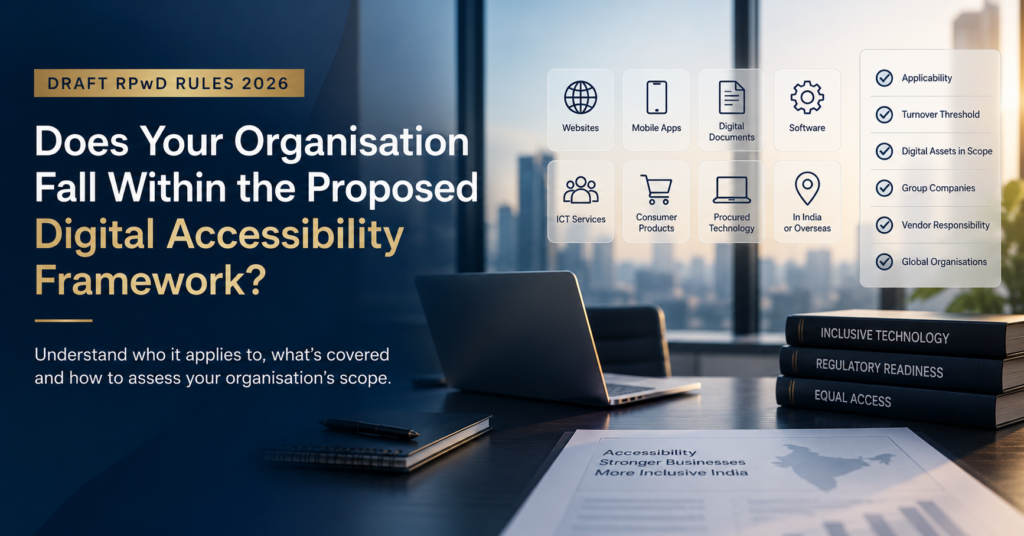
The draft published by the Department of Empowerment of Persons with Disabilities (DEPwD) proposes a broad accessibility framework covering organisations that manufacture, design, develop, exercise decisive technical control over, or directly or indirectly make specified ICT products and services available to people in India for public or consumer use.
For CXOs and compliance heads, understanding this proposed scope is an important first step towards assessing organisational readiness.
First, ₹500 Crore Is Not an Applicability Threshold
This is an important distinction.
The draft refers to a turnover threshold of ₹500 crore, but that does not mean organisations below ₹500 crore are outside the proposed framework.
Instead, turnover is used to determine the proposed timeline for meeting the specified non-negotiable accessibility requirements.
Under the draft:
Establishments with turnover of ₹500 crore or more: proposed timeline of one year from publication of the rules.
Establishments with turnover below ₹500 crore: proposed timeline of 18 months.
Separately, the draft proposes a maximum period of two years for all establishments to comply with the referenced accessibility standards in their entirety.
Therefore, an organisation should not conclude:
“Our turnover is below ₹500 crore, so these requirements do not apply to us.”
The ₹500 crore figure determines the proposed phased timeline—not whether accessibility matters in the first place.
Turnover May Need to Be Considered at a Group Level
There is another detail that enterprise compliance teams should examine carefully.
For determining applicability under the proposed rules, the definition of turnover includes the consolidated turnover of the establishment together with establishments that exercise control over it, are controlled by it, or are under common control with it, where those establishments make covered items available to people in India, including through platforms or intermediary systems.
This can be particularly relevant for organisations operating through multiple entities, subsidiaries or group companies.
Rather than considering only the revenue of the entity managing a particular website or application, compliance teams should examine how the proposed turnover definition applies to their wider corporate structure.
What Digital Assets Could Be Covered?
For many organisations, this may be the bigger question.
The draft does not restrict digital accessibility to websites.
Its proposed scope includes:
- websites;
- mobile and tablet applications;
- other touch-based applications;
- software, including documentation and support services;
- digital content and electronic documents, including non-web documents;
- ICT-based public facilities and services;
- hardware with two-way voice or video communication capabilities;
- other ICT-based hardware and electronic goods intended for everyday use;
- ICT-based consumer products;
- ICT-based accessories for general use by persons with disabilities; and
- ICT-based products used as part of public facilities and services.
This breadth is important.
An enterprise may have made its primary corporate website accessible and still have a much larger accessibility landscape to consider.
Think in Terms of a Digital Estate, Not a Website
Consider a large bank, insurer, e-commerce company, telecom provider or other consumer-facing enterprise.
Its digital ecosystem might include:
Corporate website → Customer portal → Mobile apps → Authentication and onboarding journeys → Digital forms → Statements and PDFs → Customer communication → Internal or third-party software → Other ICT-based interfaces
Different teams may own each of these.
Some may have been built internally. Others may have been developed by technology partners. Some may depend heavily on third-party products.
From a readiness perspective, this creates a practical challenge:
Does the organisation even have a complete inventory of the digital assets that may need to be assessed?
Before planning remediation, compliance teams first need visibility.
What About PDFs and Other Digital Documents?
Digital documents are particularly important because they can easily be overlooked when organisations think about accessibility.
The proposed scope expressly includes digital content, formats of such content and electronic documents, including non-web documents.
Depending on the organisation, this could mean examining accessibility across documents such as customer-facing PDFs, reports, forms and other electronic content that forms part of the digital experience.
However, the draft also introduces an important practical distinction around content.
For ACR purposes, the obligation in respect of content would generally apply to the underlying system, platform, content management system, video publishing workflow or authoring tool generating or exporting that content, rather than requiring a separate ACR for every individual content item—provided the content generated through that system is itself made accessible in accordance with the applicable standards.
So the question for organisations is not necessarily:
“Do we need an ACR for every PDF?”
It is also:
“Do our content-generation processes consistently produce accessible documents and content?”
That distinction can have a major impact on how an enterprise designs its accessibility programme.
What About Archived Content?
The draft provides an exception for archived content, but the definition is specific.
Archived content is described as content that is clearly identified as archived, is not intended for active public use or update, and is retained only for record purposes.
Such archived content is proposed to be exempt from the non-negotiable compliance requirements under the relevant clause.
This means organisations should not automatically assume that every old webpage, PDF or document can simply be categorised as archived.
A useful inventory exercise should distinguish between:
Active content | Legacy but still publicly used content | Truly archived content
That classification can help organisations understand the actual scale of remediation required.
What If Your Technology Is Procured From a Vendor?
This is another area where compliance teams should pay attention.
The draft proposes that ACR requirements apply whether the covered ICT is:
developed in-house, procured from suppliers or developers, or otherwise made available by the establishment.
The draft goes further by stating that relying on a supplier or developer’s ACR without appropriate due diligence would not absolve the establishment of responsibility.
For enterprises with significant technology procurement, accessibility therefore cannot remain solely a vendor question.
Procurement and compliance teams may need to start asking:
Does the vendor’s product meet the applicable accessibility requirements?
Is there an ACR?
How was accessibility tested?
What happens when the vendor releases a major update?
Does the contract clearly establish responsibility for accessibility issues and remediation?
These are questions that are much easier to address before procurement or renewal than after a platform has already become deeply integrated into the organisation.
What About Global Companies Offering Services in India?
The proposed scope is not limited to establishments headquartered or incorporated in India.
The draft expressly refers to establishments making covered items available to persons in India for public or consumer use whether the establishment is located within India or outside India.
This could make the proposed framework relevant to multinational and overseas organisations providing digital products or services to Indian consumers.
For global compliance teams, India may therefore need to become part of the organisation’s broader accessibility compliance strategy rather than being treated purely as a local website requirement.
Start With a Scope Assessment
Before commissioning dozens of audits, the most useful first exercise for many large organisations may be a digital accessibility scope assessment.
Create a central inventory and ask:
What do we have? → Who owns it? → Who uses it? → Is it active? → Is it internally developed or procured? → What standard applies? → Has it been assessed? → What is its current accessibility status?
The result should give management a much clearer picture of the organisation’s actual accessibility exposure.
From there, assets can be prioritised based on factors such as customer impact, usage, regulatory relevance, business criticality and remediation complexity.
This turns accessibility from an undefined organisation-wide problem into a manageable programme.
Don’t Start With Everything. Start With Visibility.
For a large organisation, accessibility readiness does not necessarily begin by auditing every digital asset at once.
It begins by knowing what you have and what may fall within scope.
The Draft RPwD Amendment Rules, 2026 provide organisations with an opportunity to conduct that exercise before the final compliance timelines begin.
Once the organisation understands its accessibility perimeter, it becomes much easier to answer the questions that follow:
Where are our biggest gaps? Which platforms should we prioritise? How long could remediation take? What should we require from vendors? And what resources will we need?
Those are much better questions to be answering today than after the compliance clock has already started.
Not Sure What Falls Within Your Organisation’s Accessibility Scope?
For enterprises with multiple websites, applications, documents, platforms and technology vendors, identifying the compliance perimeter itself can be challenging.
SaralX can help organisations map their digital accessibility landscape, assess relevant digital assets against IS 17802 and build a prioritised roadmap based on current accessibility gaps and business criticality.
The objective is not to audit everything overnight. It is to help your organisation understand where it stands, what needs attention and where to start.
Talk to our accessibility team to assess your organisation’s digital accessibility scope and readiness.