
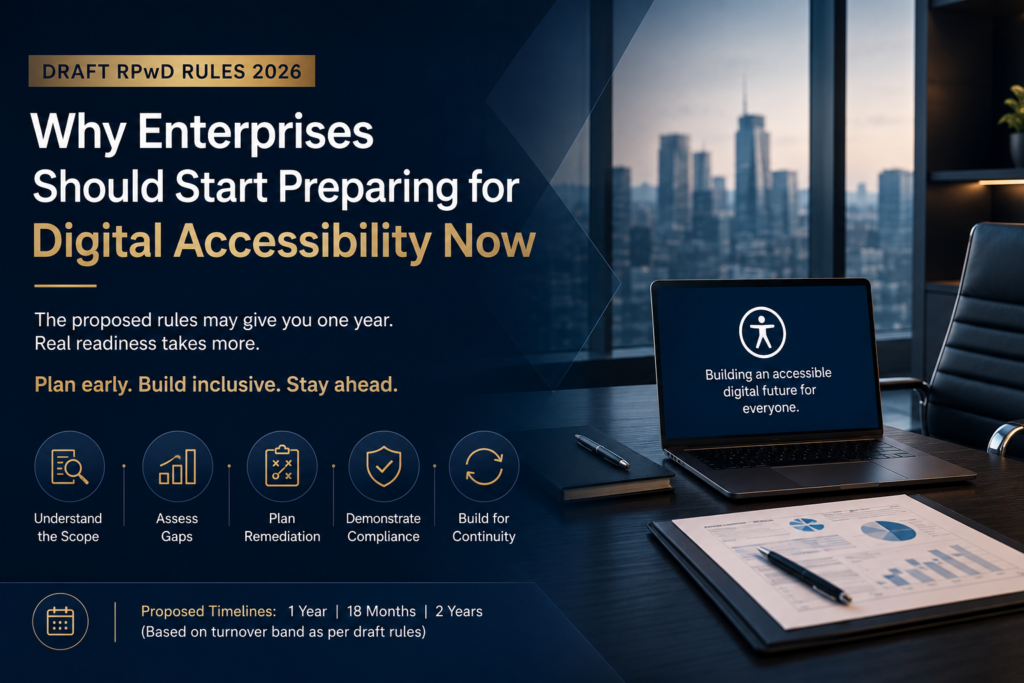
Draft RPwD Rules 2026: Why Enterprises Should Start Preparing for Digital Accessibility Now
September 2, 2026
For many organisations, digital accessibility has historically competed with multiple technology and compliance priorities.
A website redesign needs to go live. A new mobile application is being launched. Security vulnerabilities require immediate attention. Regulatory requirements have deadlines. Product teams have their own roadmaps.
Accessibility, therefore, can sometimes get pushed to the next release or the next quarter.
India’s proposed Rights of Persons with Disabilities (Amendment) Rules, 2026 provide a strong reason for organisations to reconsider that approach.
Published by the Department of Empowerment of Persons with Disabilities (DEPwD) in July 2026, the draft proposes a clearer framework for accessibility of Information and Communication Technology (ICT) products, services, documentation and digital content.
The draft follows the Supreme Court’s directions in Rajive Raturi v. Union of India, which highlighted the need to establish uniform, enforceable and non-negotiable accessibility requirements.
These are currently draft rules, and the final provisions may change.
However, for CXOs and compliance leaders, the important question today is not simply:
“When will these requirements become mandatory?”
A more useful question is:
“If these requirements come into force, how long will our organisation actually need to become compliant?”
For many enterprises, the answer may be longer than expected.
The Proposed Compliance Clock Could Move Quickly
The draft proposes phased timelines based on organisational turnover.
Establishments with a turnover of ₹500 crore or more would need to comply with the specified non-negotiable accessibility requirements within one year from the publication of the rules.
For establishments with turnover below ₹500 crore, the proposed period is 18 months.
The draft further proposes that all establishments comply with the referenced accessibility standards in their entirety within two years.
At first glance, one year or even 18 months may appear to provide sufficient time.
But accessibility compliance is rarely about fixing a few issues on a corporate website.
First, Understand How Large Your Accessibility Perimeter Really Is
The proposed framework covers a broad range of ICT products and services, including:
- websites and web applications;
- mobile, tablet and other touch-based applications;
- software;
- digital content and electronic documents, including non-web documents;
- ICT-based public facilities and services;
- certain communication hardware and electronic products; and
- other ICT-based consumer products.
The proposed scope can also extend to establishments located outside India where covered products or services are made available to people in India.
For a large enterprise, therefore, one of the first challenges may simply be identifying everything that falls within its accessibility compliance perimeter.
An organisation may have multiple customer-facing websites, mobile applications, portals, thousands of documents, customer communication workflows and platforms managed by different business units or external vendors.
Assessing and remediating this entire digital estate takes time.
An Accessibility Audit Is Only the Beginning
This is where organisations can underestimate the effort involved.
Conducting an accessibility audit identifies the gaps. Compliance happens when those gaps are actually fixed.
Remediation may involve product managers, designers, developers, QA teams, content teams, compliance teams and external technology vendors.
Some accessibility issues may be relatively straightforward to address. Others may require changes to reusable components, design systems, third-party products or underlying technology architecture.
After remediation, products need to be retested. Remaining issues need to be addressed. And subsequent releases need to ensure that already-fixed accessibility issues are not reintroduced.
For an organisation managing multiple digital assets, the journey may therefore look more like:
Inventory → Assessment → Prioritisation → Remediation → Retesting → Documentation
This is why the proposed compliance period should not necessarily be viewed as the amount of time available to start working on accessibility.
Organisations that begin understanding their current position earlier will have significantly more room to plan and execute systematically.
The Proposed Framework Is Also About Demonstrating Compliance
Another important development is the proposed Accessibility Conformance Report (ACR).
Under the draft, covered organisations would need to furnish ACRs describing the extent to which applicable ICT conforms with IS 17802 (Part 1): 2021, based on testing in accordance with IS 17802 (Part 2): 2022.
The ACR would also disclose the testing methodology, including whether automated testing, manual inspection and/or assistive technology testing was carried out, along with the scope and limitations of that methodology.
The draft further proposes that ACRs be available in both human-readable and machine-readable formats.
This means organisations should start thinking beyond:
“Have we conducted an accessibility audit?”
The more important question will increasingly become:
“Can we demonstrate our accessibility conformance?”
That requires not only testing, but also processes, documentation and clear ownership.
Accessibility Cannot Stop After the First Compliance Exercise
Digital products continuously evolve.
New features are released. User interfaces change. Content gets updated. Third-party components are replaced. Applications undergo upgrades.
The proposed framework recognises this reality.
Under the draft, accessibility conformance would need to be retested whenever a major change occurs that may affect accessibility, and the ACR would need to be updated before deployment of the upgraded or modified item.
Even where no major change takes place, the draft proposes a fresh review, testing and update of the ACR at least once every two years.
For enterprises, this is an important shift.
Accessibility should therefore not be treated as a one-time project completed immediately before a regulatory deadline.
The more sustainable approach is to gradually integrate accessibility into design, development, QA and release processes, so that maintaining compliance becomes part of normal product development.
Third-Party Vendors and Procurement Also Matter
Not every digital product used by an enterprise is developed internally.
Organisations increasingly depend on SaaS platforms, development partners, technology vendors, third-party components and externally procured products.
The draft makes an important point here: relying on a supplier or developer’s ACR without appropriate due diligence would not absolve the establishment of responsibility.
Organisations should therefore start evaluating whether accessibility is adequately addressed within their procurement and vendor-management processes.
The implications are particularly significant for government procurement. The draft proposes that government establishments incorporate accessibility requirements into procurement policies, tender documents, RFPs, contracts and evaluation criteria, wherever applicable.
For technology providers working with government, accessibility could consequently become an increasingly important part of procurement readiness.
What Should Enterprises Do Now?
Since these are draft rules, organisations do not need to treat every proposed provision as if it is already a final legal requirement.
But they can use this period to understand their current position and start building readiness.
A practical starting point can include:
1. Build an inventory of digital assets
Identify websites, applications, software, documents, platforms and other ICT assets that could fall within the proposed scope.
2. Map ownership
Determine which business unit, product owner or external vendor is responsible for each digital asset.
3. Assess current accessibility maturity
Start with high-impact and high-usage digital assets and understand the nature and scale of existing accessibility gaps.
4. Create a phased remediation roadmap
Prioritise platforms based on business criticality, usage, compliance requirements and remediation complexity.
5. Review third-party dependencies
Understand which products and components are controlled by vendors and whether accessibility requirements are adequately addressed in existing contracts and procurement processes.
6. Build accessibility into upcoming development
Fixing existing products while continuing to release new accessibility barriers will make compliance increasingly difficult. Accessibility should begin moving upstream into design, development and QA.
7. Establish internal ownership
Accessibility readiness may require coordination across compliance, legal, technology, product, procurement and business teams.
Starting these activities now does not mean assuming that every provision of the draft will become final in exactly its current form.
It means reducing the amount of work that may eventually need to be compressed into the formal compliance window.
Don’t Wait for the Deadline to Understand Your Readiness
The proposed amendment gives enterprises an important early signal about the direction in which digital accessibility compliance in India is moving.
The challenge for many large organisations may not be understanding what needs to be done. It may be understanding how much needs to be done, across how many digital assets, and how long it will realistically take.
That is why the period before the final compliance clock starts can be valuable.
Organisations can use this time to map their digital assets, assess their current accessibility maturity, identify high-priority gaps and build a phased remediation roadmap.
This does not require treating every provision of the draft as final. It simply means being better prepared for what may come next.
Not Sure Where Your Organisation Stands?
If your organisation has multiple websites, mobile applications, digital documents or other customer-facing digital platforms, a useful first step is to understand your current accessibility readiness against IS 17802 and the requirements proposed under the draft RPwD Amendment Rules, 2026.
SaralX can help your team assess your existing digital accessibility landscape, identify key compliance gaps and develop a practical roadmap for remediation—so that you are not starting from zero when the final requirements and timelines come into effect.