
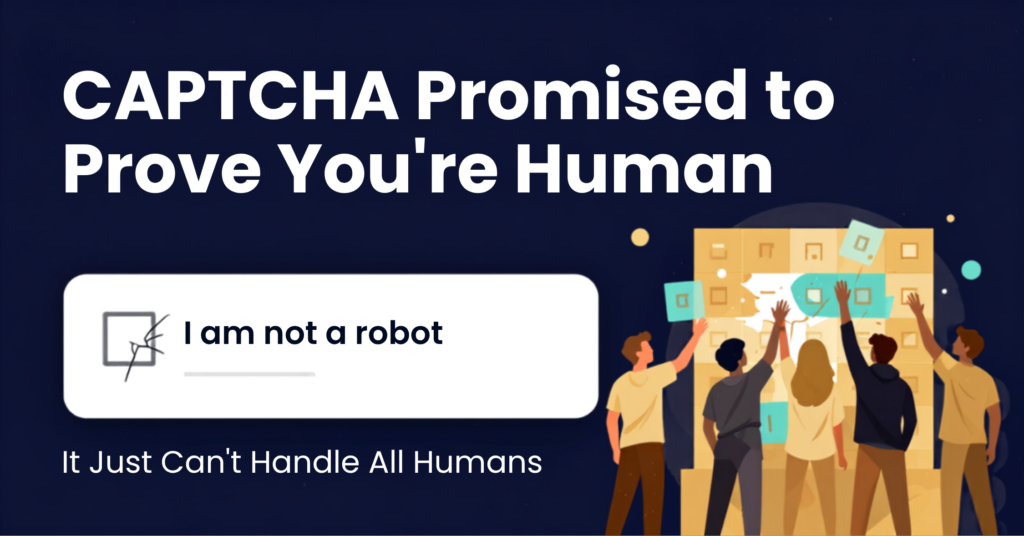
CAPTCHA Accessibility Explained: The Hidden Barrier Keeping Millions Out
July 19, 2026
By Vaishnavi
I was trying to log into a well-known website recently. Standard stuff.
Then came the CAPTCHA, a complex Captcha.
First, it showed me a gesture challenge — a reference animal was shown clearly pointing in a direction, and I had to rotate a second image of another animal to match that same direction. But the image I was given to work with was blurry and vague. The animal in it was indistinct — was it facing left? Slightly tilted? The outline gave no clear answer. I tried twice. Failed twice.
Fine. I switched to the audio CAPTCHA.
It played a sound and asked me to identify whether it was drums. Was it drums? I thought yes. Wrong. I tried again — another sound, same family of percussion. Was it a tabla? A bongo? A snare? Every option sounded like a variation of the same thing. There was no clear distinction. No piano versus drums. No guitar versus trumpet. Just drums… and drums… and something that was also drums.
I failed. The website decided I was a bot.
I am not a bot. I am a person who could not tell the difference between a tabla and a snare drum — and apparently that disqualifies me from logging in.
The Irony at the Heart of CAPTCHA
CAPTCHA stands for “Completely Automated Public Turing test to tell Computers and Humans Apart.” The entire point is to prove you are human.
But here is the uncomfortable truth: bots are now better at solving CAPTCHAs than humans are.
A 2024 study found that bots can solve image-based reCAPTCHA with up to 100% accuracy using free, open-source tools. Humans take longer and fail more often. The security theatre is running — just with the wrong cast.
Meanwhile, according to a WebAIM survey conducted in 2023-2024, screen reader users ranked CAPTCHA as the single most problematic accessibility issue on the web — above missing alt text, broken keyboard navigation, and ambiguous links. It has held that top spot for over a decade.
The system designed to keep out machines is most effective at keeping out people.
Why Audio CAPTCHA Is Not the Solution
When visual CAPTCHA fails users, audio CAPTCHA is offered as the accessible alternative. But audio CAPTCHA has its own serious problems.
Studies show visually impaired users could solve audio reCAPTCHA only 46% of the time, taking over a minute on average. The audio is intentionally distorted with background noise to confuse bots — which defeats the entire purpose of offering it as an alternative.
And my experience illustrates a different problem entirely. If this experience was frustrating for someone with no visual barriers, good lighting, a sharp screen, no assistive tools, it is worth pausing to think about what the same challenge feels like for someone who navigates the web differently every single day.
A low vision user relying on a screen magnifier sees only a small zoomed-in fragment of that blurry animal image at a time. They cannot take in the full gesture in one glance. They have to pan across the image, piece it together mentally, and then respond — all before the CAPTCHA times out. A user with a visual field condition like tunnel vision faces the same puzzle with even less context. The blur that mildly confused me becomes a complete wall for them.
When every sound option belongs to the same family — drums, tabla, bongo, snare — the distinction requires specialist knowledge, not human intelligence. That is not a Turing test. That is a music theory exam.
Piano versus drums? Anyone can tell that apart. Drums versus tabla? That depends on cultural and contextual knowledge. When a CAPTCHA asks users to identify such instruments, it becomes a complex challenge that assumes familiarity with specific cultures rather than verifying whether someone is human. Asking that question as a universal human verification test is quietly exclusionary in a way most designers never stop to examine.
What Should Replace It
Better alternatives already exist and are being used by forward-thinking platforms:
Invisible behavioral analysis — tools like reCAPTCHA v3 watch how you move through a page and score your behavior silently, no challenge required for most users.
Passkeys and device trust — verifying the device itself rather than testing the human on it.
Screen reader friendly text confirmation —a simple, clearly labeled text input with a fully readable alternative announced by the screen reader. No images, no sounds, no visual puzzles. Just a plain text challenge the screen reader can read out loud and the user can respond to by typing. It works with every assistive technology, requires no switching, no guessing, and no sensory interpretation. It is not glamorous — but it is the only CAPTCHA format that does not ask a screen reader user to do something their tool fundamentally cannot do.
The honest conversation the industry needs to have is this: CAPTCHA in its current form is not a human test. It is a sensory and cultural test — and it fails the people who need reliable access the most.
When a security system fails disabled users consistently, that is not a bug. That is a choice — and it is time to make a different one.