
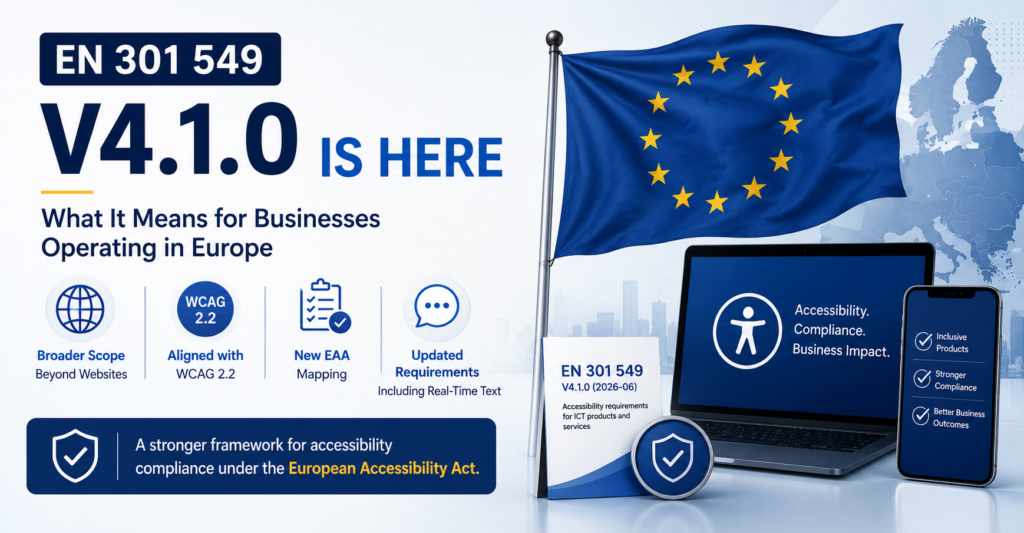
EN 301 549 V4.1.0: What Businesses Need to Know
August 31, 2026
If your organization offers digital products or services in Europe, accessibility increasingly needs to be part of your compliance, product, and technology roadmap.
The final draft of EN 301 549 V4.1.0, published in June 2026, updates Europe’s accessibility standard for ICT products and services. Importantly, this version has been prepared to provide a voluntary means of conforming to requirements under the European Accessibility Act (Directive (EU) 2019/882).
Once cited in the Official Journal of the European Union under the Directive, compliance with relevant requirements of the standard can provide a presumption of conformity with corresponding EAA requirements, within its scope.
So, what should businesses take away from this update?
1. Accessibility Compliance Goes Beyond Your Website
A common starting point for organizations is:
“Is our website WCAG compliant?”
That is important—but it may not be enough.
EN 301 549 covers accessibility requirements for a broader range of ICT products and services, including web content, software, electronic documents, hardware, communication technologies, and audiovisual capabilities.
The better compliance question is:
“Which of our products and services are in scope, which accessibility requirements apply, and can we demonstrate conformity?”
2. WCAG 2.2 Is Now More Relevant
One of the significant changes in V4.1.0 is that the clauses covering web content, non-web documents, and non-web software have been updated to align with WCAG 2.2.
If your last accessibility audit was based on an older version of WCAG or EN 301 549, it is worth reviewing whether that assessment still covers the applicable requirements.
3. EN 301 549 Is Broader Than WCAG
EN 301 549 is not simply another version of WCAG.
Its requirements cover areas such as generic ICT functionality, real-time communication, video, hardware, web, electronic documents, software, product and service information, and relay or emergency-service access.
V4.1.0 also significantly revises requirements for Real-Time Text (RTT) and extends them to include total conversation.
Which requirements apply will depend on the ICT product or service being assessed.
4. The EAA Mapping Matters for Compliance Teams
V4.1.0 introduces Annex ZB, mapping the standard to essential requirements of the European Accessibility Act.
It also introduces clause A.2, supporting evaluation of specific ICT products and services against applicable EAA requirements.
This gives organizations a more structured approach:
Applicable EAA requirement → Relevant EN 301 549 requirement → Assessment → Remediation → Evidence
What Should Businesses Do Now?
Organizations operating in the European market should consider four immediate actions:
- Identify the digital products and services that may be in scope.
- Review which standards and versions were used in previous accessibility assessments.
- Conduct a gap assessment against applicable EN 301 549 V4.1.0 requirements.
- Build a process for documenting remediation and evidence of conformity.
The Bottom Line
The EN 301 549 V4.1.0 update reinforces an important shift:
Accessibility should not be treated as a one-time website audit. It needs to become part of an organization’s broader compliance and product lifecycle.
If you are unsure where your organization currently stands, starting with a scope and gap assessment can help identify applicable requirements, current gaps, and remediation priorities.
Need help assessing your digital products against EN 301 549 and European accessibility requirements? SaralX can help you scope your digital ecosystem, identify accessibility gaps, and build a prioritized remediation roadmap.
One Response